


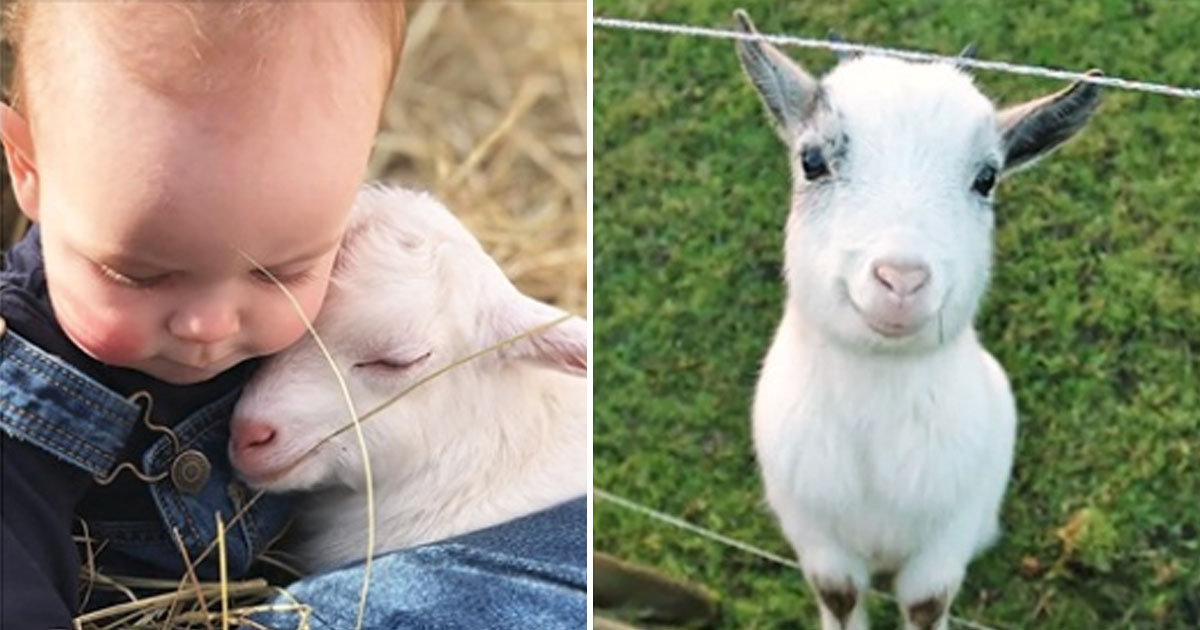


Who doesn’t like to see a smiling face?
Those who smile are generally more approachable and often give off a natural radiance that we would all like to be around.
It’s pretty well-known that we as humans can distinguish between happy and angry faces but according to a research performed at Buttercups Sanctuary for Goats in Kent, England, goats can as well.
Not only can goats distinguish between the two different facial expressions, but they are drawn to happy ones.

This is a pretty amazing observation since goats are not domesticated animals in the ways that dogs and horses are. They too have shown the ability to distinguish human facial expressions.
Dr. Alan McElligott led the study at Queen Mary University of London. He is now at the University of Roehampton but has said:
“The study has important implications for how we interact with livestock and other species, because the abilities of animals to perceive human emotions might be widespread and not just limited to pets.”
There were initially 35 goats as part of the experiment but the number dwindled to 20 after some of them weren’t able to be trained on how to move from one side of the pen to the other.

The way the study was carried out was the researchers showcased two gray-scale printouts of the same human face. The person had an angry expression in one of the photos and a happy expression in the other photo.
The goats interacted mainly with the photos of the human with a happy expression. They approached the photo and explored it with their snouts. They also spent more time on the photos with the person smiling.
The team published the study in Royal Society Open Science, and stated the goats, “preferred to interact first with happy faces, meaning that they are sensitive to human facial emotional cues.”

The study was performed in four sessions. In each one, half of the goats were shown male faces and the other half we shown female faces. They also switched the sides of where the photos were placed. Sometimes the happy photo was on the right and other times on the left.
They did notice, however, that the goats showed preference of the happy photos when they were placed on the right.
This led researchers to believe that goats may process friendly social cues from the left side of their brains.
Goats wouldn’t be the only ones who do this. Horses also show bias to the right side when processing “pro-social stimuli.”

The reason why horses, dogs, and goats can discern between happy and angry human expressions has yet to be explained. One possible reason is that they are all domesticated in some way.
While horses and dogs have been domesticated as human companions, goats have been domesticated for food production.
Jérôme Micheletta, an animal behaviorist at the University of Portsmouth, said that just because goats may not have been selected for being friendly or responsive to humans, “doesn’t mean (their domestication) didn’t have an effect on their ability to understand human signals.”

Leanne Proops, an animal behavior researcher at the University of Portsmouth in the United Kingdom said:
“The other option is that it’s not domestication; it’s just something about dogs or something about horses, whether they’re wild or domestic, that makes them good at this sort of ability.”
Regardless of the reason, McElligott simply hopes the study can be the start of improving the welfare of goats.
“Ultimately our overall goal is to improve perceptions of these species so that people really understand the behaviors . . . and therefore might actually treat them a bit better.”

Please SHARE this with your friends and family.


