




Sugar gliders, without a doubt, are among the cutest animals on the planet. They’re indigenous to Indonesia, Papa New Guinea, and Australia.
These omnivorous marsupials can glide considerable distances despite not having wings. They can even be domesticated as pets in certain parts of Australia.

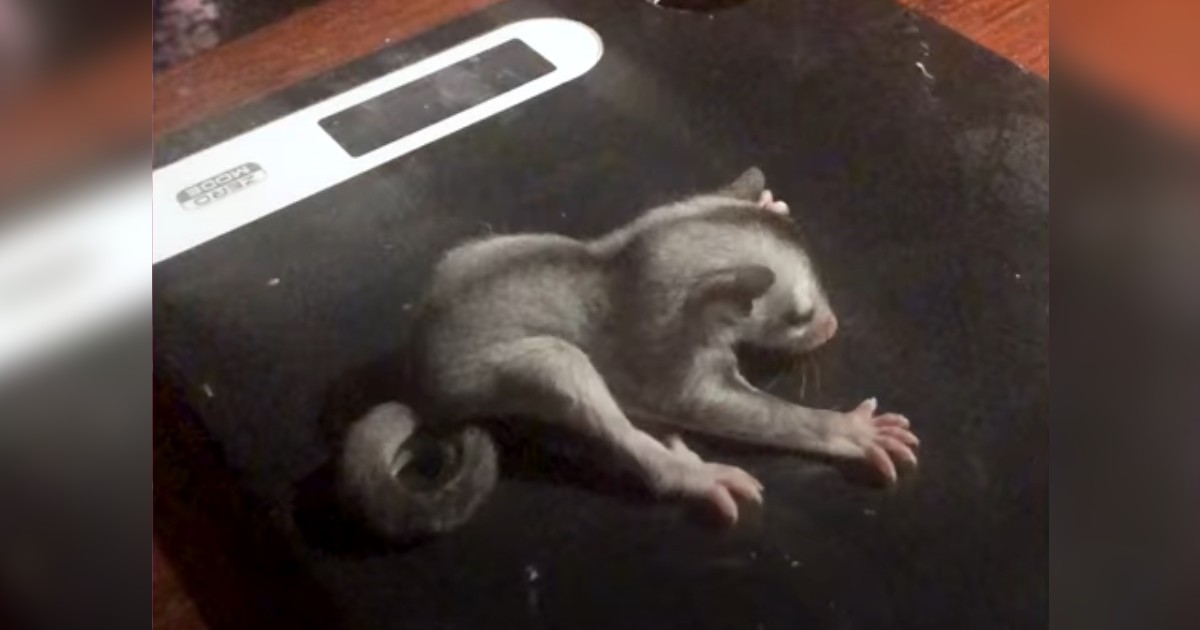
The Australian Daintree Ice Cream Company recently rescued a struggling, wild infant sugar glider.
A member of the company recalls that fateful day, “Someone had found a little mammal on the side of the road next to the pub.”
Jenna Rumney, a wildlife rehabber, recalls her initial conversation with the group, stating, “They weren’t sure what it was and they said it was absolutely tiny.”
After a basic physiological evaluation, rescuers noticed he was dehydrated and malnourished. A scale confirmed their suspicions.

Jenna states, “You couldn’t even feel the weight of him in your hand.”
His life was seriously in doubt the first few days after rescue. The team proceeded to feed him, closely monitoring his response and vitals.
“After about 48 hours, we thought ‘OK, I think he’s gonna make it. He’s really a fighter.'”
They decided to name him Vern, beginning the parenting process.

Although often compared to flying squirrels, a gliding rodent, the sugar glider’s actually more closely related to kangaroos and other marsupials.
But Vern’s special, possessing an especially warm personality. “He was the biggest snuggler I’ve ever seen,” says Jenna. Absolutely adorable.

The rescue team continues to feed Vern and monitor his health as the days and weeks go by. His quick growth becomes more and more apparent.

He soon matures into a phenomenal acrobat. Climbing, long jumps, and short glides become the norm.

Vern’s incredibly active, effortlessly darting across a room on a whim. His aerodynamic frame’s built for speed, not power.
And he’s always up for a game of hide-and-seek.

Eventually, time came for him to move to an outdoor enclosure – a perfect environment for his high motor. The locale gives him appropriate space to foster his gliding and climbing abilities as he matures.

The rescue team always sought to release Vern into the wild one day. The time came for Vern to socialize with other sugar gliders. Fortunately, two others made their way into care around the same time as Vern, joining him in the enclosure.
Jenna recalls:
“And I brought Vern out to meet them. And as soon as he saw them, he was very alert. And he looked at them. And he sniffed. And then he just bounded over to meet them, just so excited!”

Sugar gliders are relatively social creatures, nesting in trees with up to 10 other adults. They’re generally found in forests, plantations, and gardens. Diets consist of acacia, eucalyptus, and nectar. They seem to make surprisingly good pets.
In a bittersweet goodbye, Vern exits the door and grapples a nearby branch, soon meeting up with his friends. Free at last.

Although somewhat sad, he still comes back to visit every now and then.
“We do still see them occasionally in the trees around our house. But they’re completely and utterly wild now.”
Vern lives out his days in the wild, surrounded by friends and a nearby, loving human mother and family. He’s grown from a vulnerable, unhealthy infant to a strong, self-sufficient adult. Despite humble, difficult origins, things look bright.
Now, he can truly spread his (figurative) wings.
Please SHARE this with your friends and family.


